
The short answer
For most homeowners, small businesses, and tight job sites, a 20-foot container is the practical default. It holds a surprising amount and fits where space is limited. Step up to a 40-foot container when you need maximum capacity, room for long materials, or you would otherwise rent two smaller units. Both are weatherproof, lockable, ground-level steel boxes; the real differences come down to capacity, footprint, and how much clear space you have for delivery.
20-foot containers
Container sizes are standardized worldwide under ISO 668, the international standard for series 1 freight containers, which sets a 20-foot unit at 19 ft 10.5 in long and 8 ft wide. In practice, a 20-foot unit is the workhorse of portable storage. It is easy to place, fits on most driveways and lots, and still swallows the contents of a typical two- to three-bedroom home or a single-car garage.
- Residential moves, remodels, and decluttering
- Tools, equipment, and supplies on smaller job sites
- Seasonal or overflow inventory for shops and offices
- Properties where access or parking space is tight
40-foot containers
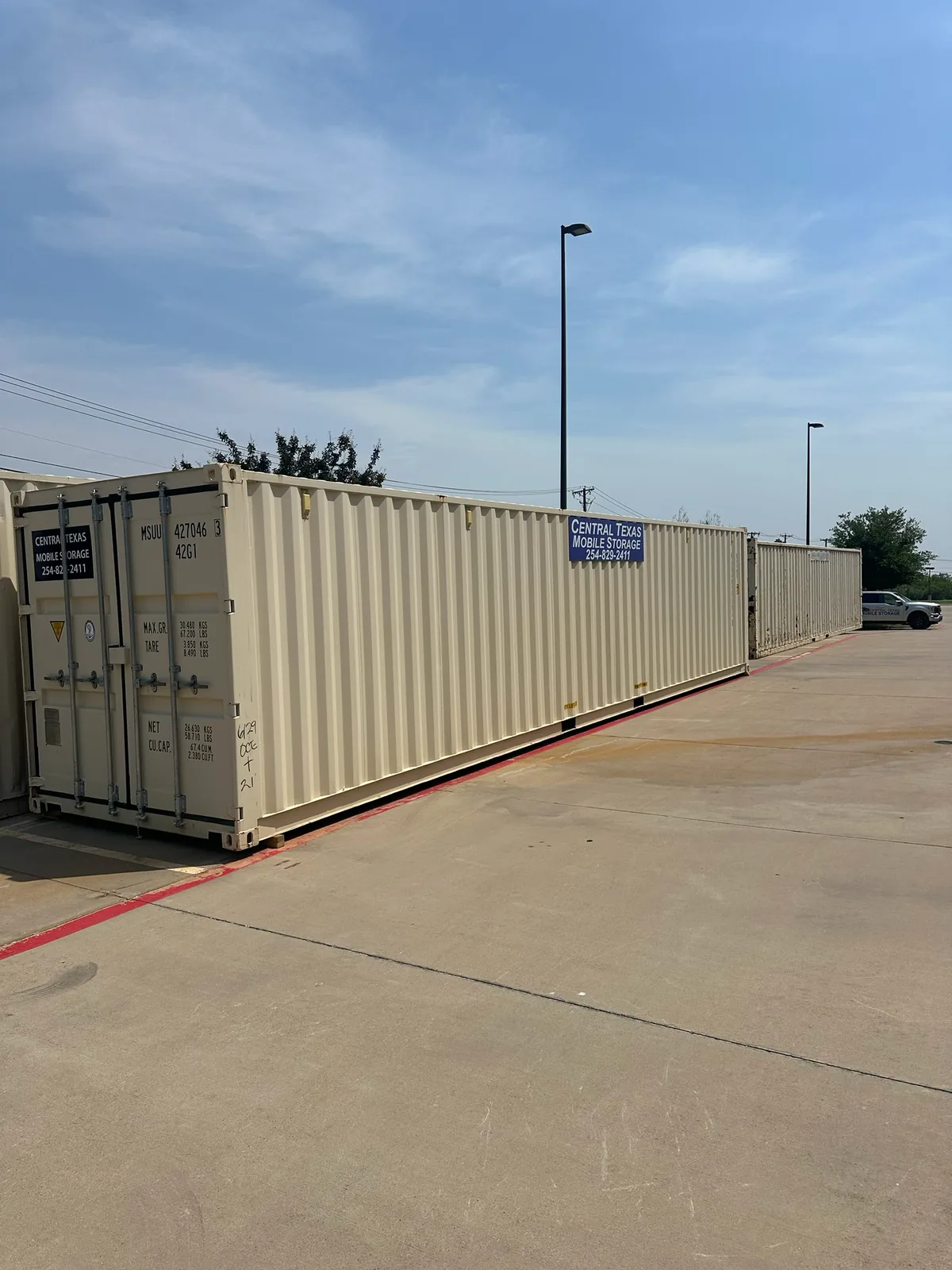
A 40-foot unit gives you roughly double the floor space in a single delivery. It is the better value per square foot when you genuinely need the room, and it keeps long items, lumber, pipe, racking, and furniture, together in one secure space.
- Large inventory, equipment, or whole-home storage
- Long-term construction and commercial projects
- Businesses consolidating storage instead of leasing warehouse space
- Anyone who would otherwise rent two 20-foot units
Both sizes are also available as high-cube containers, which add about a foot of interior height for tall or bulky loads.
| Feature | 20-foot | 40-foot |
|---|---|---|
| Exterior dimensions | 20 ft L x 8 ft W x 8 ft 6 in H | 40 ft L x 8 ft W x 8 ft 6 in H |
| Approx. floor space | About 150 sq ft | About 300 sq ft |
| Approx. storage volume | About 1,170 cu ft | About 2,390 cu ft |
| Rough capacity | A 2-3 bedroom home or one-car garage | A 3-5 bedroom home or two-car garage |
| Best for | Tight lots, residential moves, tools and equipment | Large inventory, long items, maximum capacity |
| Delivery footprint | Needs less straight-line space | Needs a longer, clear approach |
How to choose
Three questions settle most decisions:
- How much are you storing? If a one-car garage would hold it, a 20-foot unit is usually enough. If you are filling a two-car garage or more, look at the 40-foot.
- How much room do you have? Delivery trucks need a clear, straight approach to set a container down, and a 40-foot unit needs noticeably more length to maneuver. If you are unsure, our team can help you measure.
- How long do you need it? For long projects, the extra capacity of a 40-foot often costs less than renting and re-renting smaller units.
Before delivery day, it is worth reviewing how to prepare your site so placement goes smoothly.
Still deciding?
We rent and sell both sizes across Central Texas and we are happy to talk through your project. Explore container rentals, containers for sale, or request a quote and we will recommend the right fit.